I needed a new bed after moving.
For the frame, I ordered a King Size solid wood bed frame with storage drawers from Bob's Discount Furniture.
The mattress came from Wayfair — a Simmons Beautyrest Silver BRS900, Extra Firm, with individually pocketed coil springs. Fun fact: the Simmons brand name is the origin of "席梦思" (Xí Mèng Sī), the generic term Chinese consumers use for spring mattresses.
I like a firm feel — solid, supportive under the back, no sinking when you roll over. Extra Firm was exactly what I was after.
When the delivery crew from Bob's brought the frame in, both white-glove installers said the same thing unprompted: "This bed is really heavy." Once it was set up, I could confirm — solid and sturdy.
But the slats on top of the frame were spaced too far apart. I measured: each slat was 2.5 inches wide and 0.6 inches thick, with gaps of nearly 3.5 inches between them.
Putting the mattress directly on that wasn't going to work. A pocketed coil mattress has each spring individually wrapped in fabric — there's no interconnecting steel wire forming a grid. Based on the spring count for my model, each coil pocket is roughly 2.1 inches in diameter. With gaps that wide, every spring would be affected:
- Springs sitting directly over a gap lose their support entirely, sag downward, and stop doing their job.
- Springs partially over a gap bear uneven loads and are prone to twisting out of shape.
- Even springs that land squarely on a slat end up carrying disproportionate weight, causing them to wear out and lose tension faster.
This doesn't just mean an uneven sleeping surface and internal damage over time — Simmons will also void the warranty outright if the gap exceeds 2 inches. Their official Warranty Instructions are explicit: gaps between slats must not exceed 2 inches.
So what to do?
American Beds vs. Chinese Beds
Back in China, mattress support was never something I thought about.
Beds there were simple: a frame with a solid wood board on top, a cotton mattress pad, a sheet, done. I also slept on palm fiber mattresses for a while — rock hard. The elders always said that was good for your bones and spine. These days everyone uses mattresses, but the solid board base is still standard. Support was never a problem; it never crossed anyone's mind.
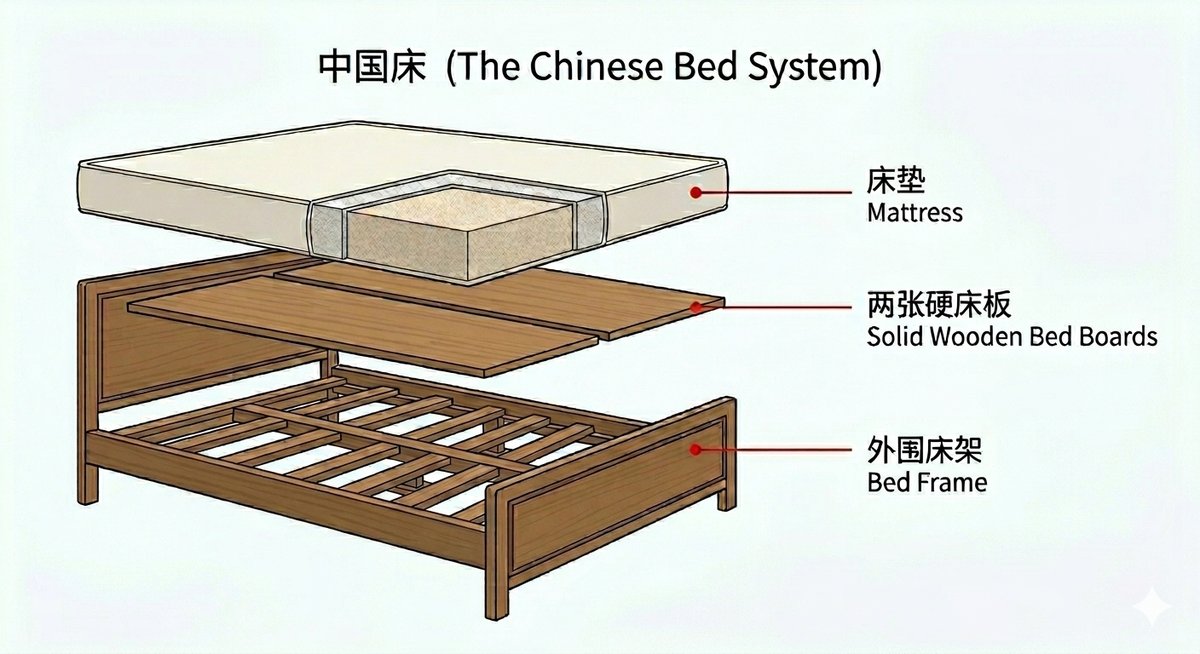
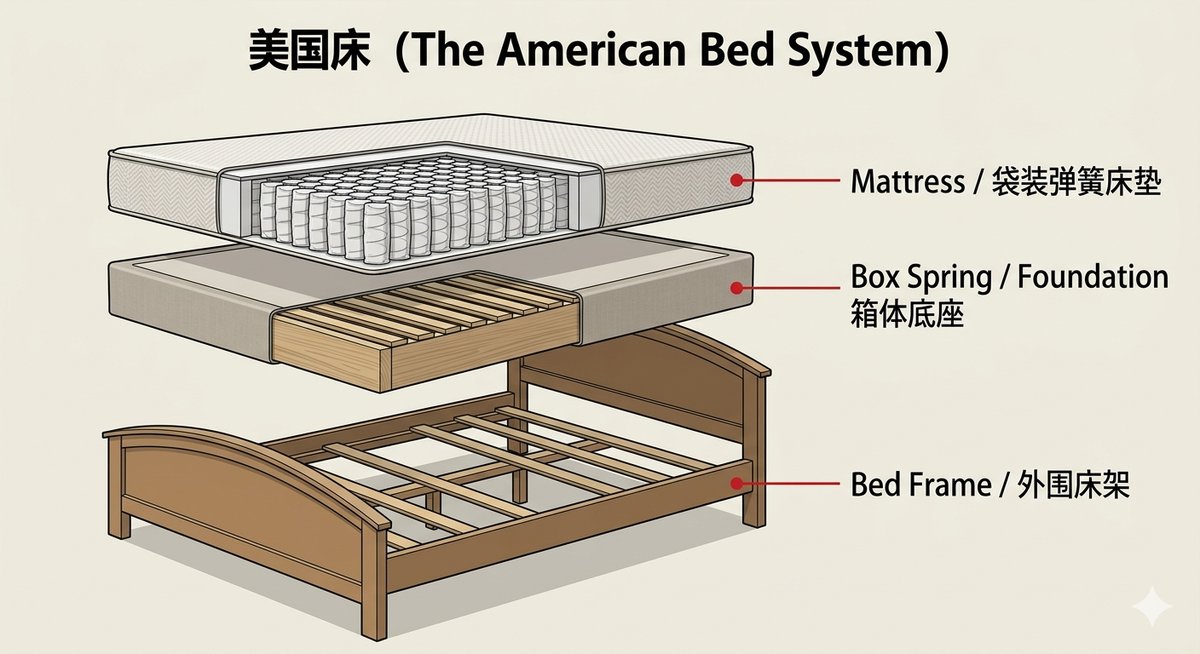
Coming to America, I found things work completely differently. The standard American bed has three layers: frame + Box Spring + mattress.
The frame itself is just a border with legs and a few sparse slats running across.
Because that alone can't support a mattress properly, a Box Spring goes in between. Originally, a box spring was literally a box filled with springs — essentially a simple spring mattress in a box shape, designed to add bounce and raise the overall bed height. Today, nearly all box springs have no springs at all. They've been replaced by a layer of closely spaced slats on top of a wooden frame, wrapped in the familiar knit fabric — but still built in the same boxy shape.
That's why American beds tend to sit so high — raising the height was part of the box spring's original purpose.
The Options
So what were my choices?
Box Spring — ruled out
My first thought was to just add a box spring. But the slats inside modern box springs are spaced roughly 2–3 inches apart as well, so adding one would accomplish nothing.
Bunkie Board — ruled out
I asked an AI for suggestions, and it recommended a Bunkie Board.
After researching extensively, I could see the idea: it's designed to go between the frame and mattress to solve exactly this kind of support problem. But after looking at a lot of products on the market, I wasn't convinced.
Bunkie boards come in two types. The first uses internal slats with a fabric cover — the slats are a bit closer together (1–2 inches), slightly better than the bed frame, but still gapped. The second type uses a solid panel inside with a fabric cover.
The solid panel type sounds right, but on closer inspection the materials are almost universally particleboard or MDF — both prone to off-gassing, moisture warping, and a lifespan of only 5–10 years.
Foundation — ruled out
The AI also suggested a foundation. Looking at what's actually sold, a foundation is essentially the same thing as a modern springless box spring: same height, fabric-wrapped exterior, wooden frame inside, no springs, slats spaced about 1–2 inches apart — and priced at $200–$400. Pass.
Adding more slats — ruled out
This was the DIY angle: add more slats between the existing ones to bring the spacing down to 1–2 inches. Theoretically workable, but a King Size frame has an interior width of 76 inches, which isn't a standard dimension, so the slats would need custom cutting. Then each one would have to be installed and spaced evenly. More effort than it's worth, with too much room for error.
The actual solution: plywood
Cut a few sheets of plywood to the bed's dimensions, lay them flat on the existing slats, put the mattress on top. Solid, 100% even support. It's the same logic as the traditional Chinese bed board — just a different material.
At Home Depot — What to Say
I went to the Home Depot on North Ave in Chicago. Weekdays between 10am and 2pm are the best time — the cutting station is least busy and wait times are short.
I picked up two sheets of SANDEPLY 12mm Sande Plywood, 1/2 in. x 4 ft. x 8 ft., sanded surface finish, at $53.73 each. Two sheets for a King Size comes to $107.46. Home Depot cuts for free. I also grabbed a roll of black Duct Tape to hold the panels together.
My frame has 13 slats spaced fairly evenly, and with a 3.5-inch span between them, 1/2-inch plywood is thick enough — no sagging.
Load the sheets onto a flat cart and wheel them to the cutting station. Here's what to say:
Please cut these TWO 4x8 sheets into FOUR pieces total. Each piece should be 38 inches by 40 inches. Please account for the kerf so the final combined width equals 76 inches. Discard the remaining scraps.
One important detail: always ask them to account for the kerf. The saw blade itself has thickness — each cut removes about 1/8 inch of material. If you ignore this, the two panels won't quite add up to 76 inches when placed side by side. Let the staff handle the math; they do this all day and will get it right.
A King Size is 76 × 80 inches. Two 4×8 sheets, each cut into two 38×40-inch pieces, gives you four panels total.
Transport and Installation
The reason to cut into four pieces rather than two 38×80-inch panels is simple: my car isn't big enough for an 80-inch panel. With four pieces, I folded down the rear seats and stacked them flat in the back. Each panel is 38×40 inches — about a meter long — so nothing pushed against the front passenger seat or blocked the right mirror. Perfectly manageable. If you have a pickup truck, two panels are enough.
Pad the edges with an old blanket to avoid scratching the car's interior trim.
Back home, I rinsed the panels off and left them outside to air out for a bit — plywood does have a smell.
Installation was fast: starting from the headboard, lay all four panels flat, working toward the foot. They'll naturally leave about a 1-inch gap around the perimeter, which is actually good for airflow. Run Duct Tape over the cross-shaped seam in the center to keep the panels from shifting.
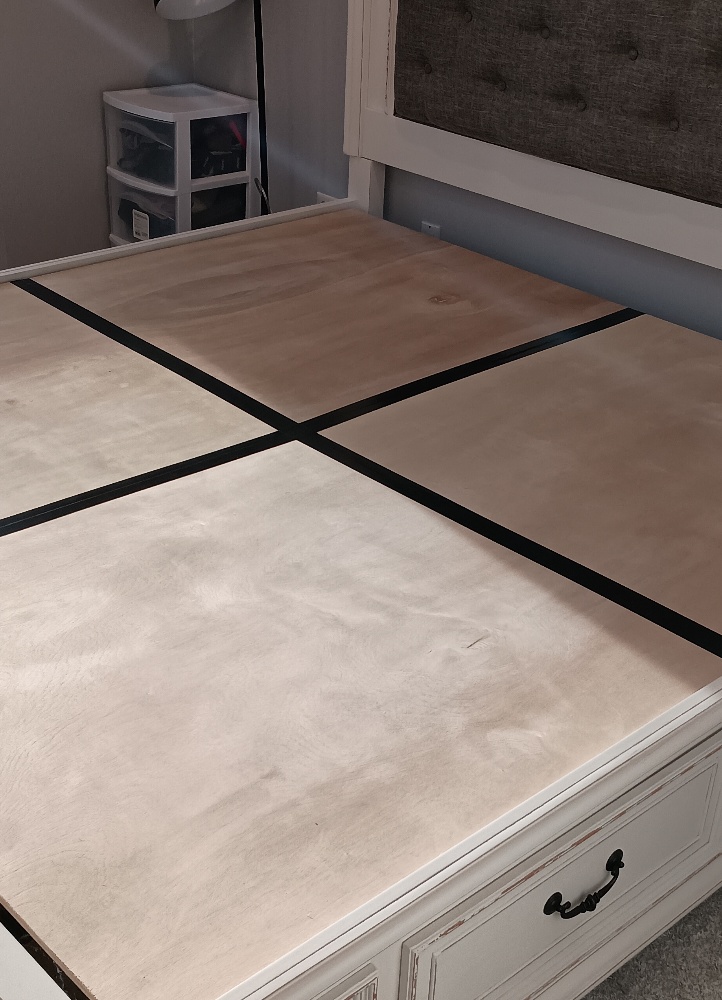
When the mattress arrived, I set it straight on top.
How It Feels
Rock solid.
The Extra Firm feel comes through completely — no localized sinking anywhere. Rolling over, getting up, the entire surface holds. Two people sleeping doesn't affect the other side at all.
Exactly what I wanted.
On airflow: a solid panel does restrict circulation underneath compared to slats, but the bed frame is open on all four sides, so air can come in from the edges. If you live somewhere humid or tend to sleep hot, drill 1/2-inch holes every 6 inches across the panels — airflow improves dramatically with almost no effect on structural rigidity.
Final Thoughts
Bunkie boards and foundations are, at their core, fabric-wrapped thin panels or slat assemblies. You're paying for the packaging. Plywood is thicker, stronger, more durable, and costs less than half the price. If your bed is a platform frame that was never designed for a box spring, this is the most practical solution I've found.
Cost comparison: Bunkie Board $100–$300, Foundation $200–$400, two sheets of Sande Plywood $108, Home Depot cutting free.
None of this is a new idea. It's just the logic of the traditional Chinese bed board, applied in America. Went the long way around, and ended up back at a solid surface.
不买 Bunkie Board:用胶合板解决床架 Slats 间距问题
床架木条间距3.5英寸,超出Simmons质保要求,Box Spring、Bunkie Board、Foundation逐一排除之后,最终用两张Home Depot的胶合板裁切铺底,$108解决问题。附裁切尺寸、kerf细节和Home Depot沟通话术。
read moreWSL2 Under the Hood: One VM, One File, One IP That Never Stays the Same
Once WSL2 is up and running, some strange things start to happen: you delete gigabytes of files in Linux and Windows disk usage doesn't budge; cross-system file access is painfully slow; a network script that worked fine yesterday suddenly breaks after a wsl --shutdown. None of this is a bug. It all traces back to three things at the core of WSL2's design — a special kind of VM, a single file that holds your entire Linux system, and an IP address that changes every time you restart.
read moreWSL2 底层:一个虚拟机、一个文件、一个会变的 IP
装好 WSL2 之后,用着用着就会碰到一些奇怪的问题:Linux 里删了几十 GB,Windows 磁盘纹丝不动;跨系统访问文件,速度慢得离谱;网络脚本昨天还好好的,重启 WSL 就连不上了。这些都不是 Bug,根子在 WSL2 的底层设计——一个特殊的虚拟机、一个装着整个 Linux 的文件、还有一个每次重启都会变的 IP。搞清楚这三件事,那些让人懵的问题就都说得通了。
read moreInstall Linux on Windows 11 in 5 Minutes
A practical guide to building a native Linux environment on Windows 11 using WSL2, bypassing the resource overhead of traditional virtual machines. Covers enabling BIOS virtualization, one-command deployment with wsl --install, file system mapping, and a warning about the irreversible data erasure caused by --unregister.
Windows 11 下 5 分钟安装 Linux
详解利用 WSL2 在 Windows 11 下构建原生 Linux 环境的实战流程,避开资源繁重的传统虚拟机。 涵盖 BIOS 虚拟化开启、wsl --install 一键部署及文件系统映射机制,并预警 --unregister 彻底抹除数据的风险。
read moreI Built a Study Tool While Preparing for CompTIA A+ — Now It's Open Source
I was studying for CompTIA A+ when I got frustrated with reviewing wrong answers in a plain document. So I built a tool — and now it's open source.
read more备考 CompTIA A+,我用 Python 做了个错题练习工具
备考 CompTIA A+ 期间,用文档记录错题越来越不方便,于是我用 Python 做了一个交互式的错题练习工具,现已开源。
read more龙龙读书记1:爱上植物的第一本书
天下没有不爱阅读的孩子,关键是要找到孩子的兴趣!所以对于家长来说,培养孩子的阅读习惯,从发现孩子的兴趣开始。
read more科幻故事 | 咖啡留香:一次关于意识上传的实验记录
"意识不是被给予的,而是不断创造的。"这是李元教授生前常说的一句话。作为一名量子物理学家,他用自己最后的时光,完成了一场惊世骇俗的实验。
read moreTkinter根窗口设置小技巧:程序启动最大化和程序窗口图标设置
介绍Tkinter程序根窗口的设置方法,同时介绍程序启动时窗口最大化和程序窗口图标设置的小技巧。
read more孩子运动,是选篮球还是足球??
篮球和足球都是团体对抗的球类运动,训练方式也相似,对于提高身体素质,培养孩子的对抗意识和团队合作意识很有帮助。但是因为运动形式的差别,篮球更有利于身体的全面锻炼,对孩子长身高有帮助,同时也有利于脑部发育。
read more2020年温针灸足三里筑基记录
2018年的温针灸足三里百次筑基,对我的身体有很大帮助。今年准备再次温针灸足三里,希望经过三伏天,重新百次筑基。6月1号开始第一次,特记录如下。
read morePython自带的GUI库Tkinter是否值得学习?
Python语言可以用在很多方面,网站开发、数据分析、运营维护、游戏开发等等,那么桌面应用程序GUI呢?其实Python标准库里自带Tkinter就是干这个的。相比PyQT、wxPython等等,Tkinter有哪些优势和不足,是否值得学呢?
read more站桩记录2:调身、调气和调心
站桩的过程实际上首先就是“调身”的过程。“下紧上松”,从双脚开始,到膝盖,再到裆部的放松。上半身则要求头部顶悬、下颌微内收;松肩沉肘,双掌环抱。
read more站桩记录1:开始练习站桩
创意与验证:如何获得好的创意?——Udacity课程《产品设计》学习笔记2
要想有一个好的创业点子,一定要对所做的事情有激情。千万不要只是为了创业而去创业。我们之所以要创业,是因为要解决一个问题,一个会让我们日夜寻思的问题。
read moreBreeze,让无车者也能成为Uber/Lyft司机
对于Uber和Lyft这样的打车平台来说,随着对出行市场的占有率越来越高,他们面对的问题和别的行业有所不同。对于他们来说,获取用户非常简单,甚至太简单了,导致现在他们常常面临的问题是:用户太多,而司机太少。
read more创业者应该具有怎样的素质?——Udacity课程《产品设计》学习笔记1
企业家是否能够培养?这本身就是一个问题。一个企业家所扮演的角色非常广泛,除了企业内的经营管理工作,还有很多企业外的作用,所以要找到一个简单的成功公式非常困难。
read moreInstacart创业者早期的故事
故事从2010年1月说起,80后的Apoorva Mehta在亚马逊已经工作了2年,作为一个开发工程师,他在亚马逊学到了很多,但同时也开始对公司里缓慢官僚的气氛有些感到厌倦,他希望有所改变。
read more美式音标练习笔记——“李阳疯狂英语手势突破发音”
本文是我为了练习美式英语而学习美式音标的笔记,采用了“李阳疯狂英语手势突破发音”教程。
read more如何去除Joomla 3网站静态化URL地址中的分类ID和文章ID
Joomla是一个非常专业的网站内容管理系统(CMS),但是其在SEO搜索引擎优化后的URL模式上有一些不足。这里记录了我的一些改进方法。
read moreRemove Category and Article ID from URL in Joomla 3
Joomla is a very professional content management system (CMS), but there're some minor shortcoming within the SEO URL Mapping.
read more深深网络深似海----搜索引擎之外的网络世界
互联网是一个信息的海洋,那么搜索引擎抓取只是这个海洋的表面,而在信息海洋的深处,存在巨大数量的内容,搜索引擎无法启及,这些内容叫着“DEEP WEB”,或者“INVISIBLE WEB”。
read morerobots.txt和Robots META标签
对于网站管理者和内容提供者来说,有时候会有一些站点内容,不希望被ROBOTS抓取而公开。为了解决这个问题,ROBOTS开发界提供了两个办法:一个是robots.txt,另一个是The Robots META标签。
read moreRSS及其发展历程简介
RSS是一种描述和同步网站内容的格式,是目前使用最广泛的XML应用。RSS应用在国外已经非常普遍,从个人博客(Blog)栏目、企业站点到世界级的门户都提供基于RSS的服务。
read more网络推广新潮流——发行免费电子图书
使用免费电子图书进行营销就像共享软件一样,非常流行。它真正体现了为访问者着想,同时用户也可以收藏,以备进一步的阅读参考。每一本电子书一旦放到网上,就如同有了自己的生命,到处传播,不需要我们再去费心,同时电子书籍又可以保证内容的完整。
read more如何迅速增加电子杂志的订户数
当我们建立起一份电子杂志后,除了系统的管理、内容的准备等等外,最终也会面对临一个推广的问题:怎么样能迅速扩大自己的知名度,增加杂志的订户数呢?
read more自动回复机----电子邮件营销中的另一种秘密武器
小小的电子邮件,有这么多的应用方法,而且还在不断诞生着一些极具创造性的新应用。这里想给大家介绍的是电子邮件营销中的另一个秘密武器:自动回复机(AutoResponder)
read more网上淘金——新世纪的八条网络解决之道
互联网究竟能不能赚钱,除了依赖那些风险基金、为上市奋斗外,我们是否还有其他方式生存和发展呢?
read more让用户知道你——建设企业网站之推广篇
初步完成一个站点的设计建设,只是企业网站经营的开始。为了真正发挥一个站点的作用,我们要以该站点为基础,在网上网下开展长期而有效的推广工作。
read more组织网站内容——建设企业网站之建设篇
在做完“企业网站定位”工作、确定了网站“为什么做”和“为谁而做”,接下来就需要根据目标访问者的潜在需求确定网站的内容。
read more为什么做与为谁而做——建设企业网站之定位篇
建设一个企业网站,首先需要做的应该是确定建站的目的,也就是确定为什么做和为谁而做的问题。
read more企业网站的4种模型
互联网上每个站点都有其商务模式,虽然这些模式是千差万别的,但实际上都可以归结到4种典型的商务模式上来,这些模式构成了网站的基础结构。
read more