How Should We Use AI in Education?
Over the past two years, AI has moved quickly into schools, and into kids’ everyday learning.
That leaves a lot of parents and teachers facing a very practical question:
Should students be using AI at all? And if so, when?
Should they struggle through a problem on their own first, and only turn to AI when they’re truly stuck? Or is it fine to use it from the very start?
I’ve been thinking about this myself. As a software developer, AI has worked its way deep into how I do my job. At the same time, my son just started high school, and AI is inevitably becoming part of how he learns.
My first instinct was the conventional one: do the work yourself first, let AI come in later.
But eventually I realized the real question is something else:
What is the point of homework, essays, and problem sets in the first place?
The Assignment Isn’t the Goal — It’s the Target You Train On
Say a history teacher assigns this essay prompt:
To what extent was the American Revolution driven by economic factors?
A student could hand that straight to AI — thesis, evidence, structure, maybe the whole essay.
As a way of getting the assignment done, that’s extremely efficient.
But the teacher didn’t assign the essay because the world needed one more paper on the American Revolution.
Clearly not.
The point is what happens to the student while writing it — reading the material, weighing competing explanations, forming a judgment, and learning to express it clearly.
Education isn’t about finishing the task. The task is just the target you train on.
If AI shoots the arrow and hits the bullseye for you, that doesn’t mean you’ve learned archery.
The same goes for math, programming, English. What we actually want isn’t a correct answer, working code, or a polished sentence — it’s the understanding, reasoning, judgment, and expression that the task is meant to build.
So there are two different things to track:
The task got done.
The person learned something.
Sometimes both happen together. Sometimes only the first one does.
Which means the real question about AI in education isn’t just “should students use it” — it’s:
How does AI’s involvement actually help this student build ability?
Two Different Ways to Use AI
That question led me to think about AI in two modes.
One is AI as Agent: hand it a task, let it get the task done.
The other is AI as Tutor: use AI, through tasks and back-and-forth, to build your own ability.
These aren’t two different products — they’re two different goals for using the same technology.
As a developer, I feel this distinction constantly.
If my goal is to ship a website, I want AI to help as much as possible — design the schema, write the code, run the tests, handle deployment. The more it reliably takes off my hands, the happier I am. That’s AI as Agent, because my goal really is just: get the website built.
But if I’m using that same project to learn JavaScript, things change.
If AI writes the whole thing, the site gets built, but I may not have learned JavaScript at all. What I need now is for it to explain the code I don’t understand, compare design choices, push back on my assumptions, or point me toward a bug instead of just fixing it.
AI can still be involved the entire time — what’s changed is the goal, from “do this for me” to “help me get better at this.”
So, put simply:
An Agent helps us finish tasks.
A Tutor uses tasks and interaction to help us build ability.
The difference isn’t whether AI gives you an answer, or how many questions it asks. It’s what we’re actually optimizing for.
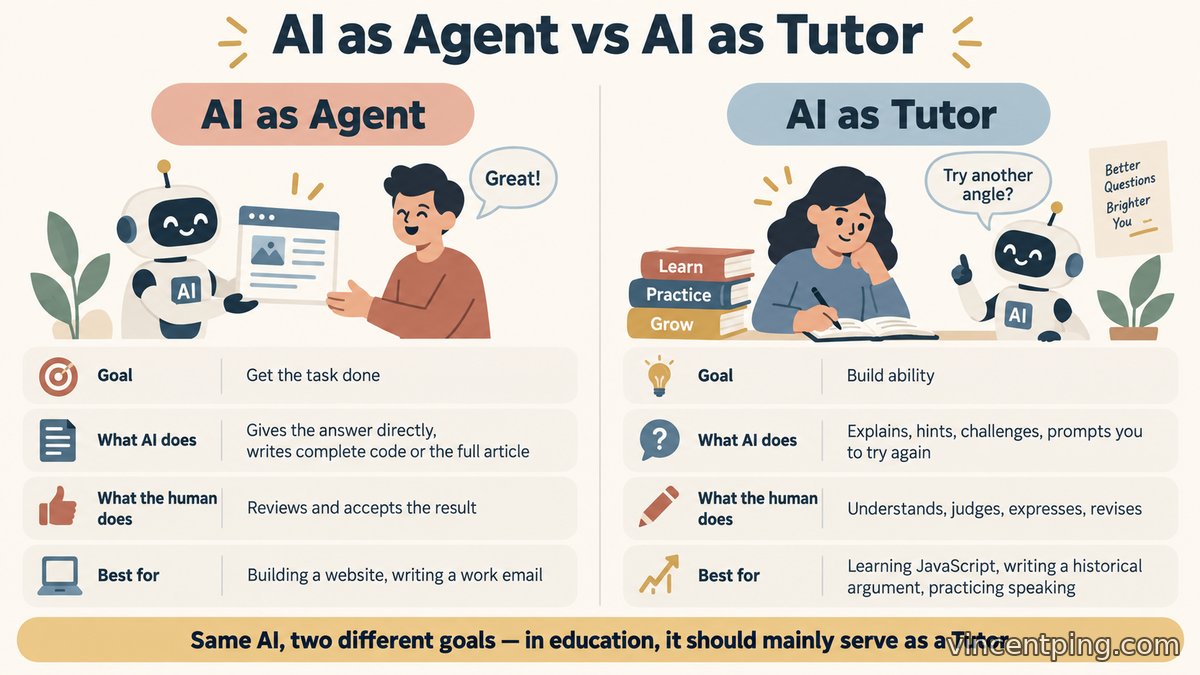
In education, AI should mainly be used as a Tutor.
What Does It Actually Mean to Use AI as a Tutor?
Once you frame it this way, the question isn’t “is AI allowed to just give me the answer” — it’s:
What ability am I trying to build right now, and how can AI help build it?
Help Us Understand — Not Just Hand Us the Solution
A kid gets stuck on an algebra problem. AI can write out the full solution. The kid reads it, thinks “oh, I get it,” and moves to the next one.
The problem is, understanding a solution isn’t the same as being able to produce one.
Using AI as a Tutor doesn’t mean it can never show a solution — it means the solution can’t be the endpoint.
If the student is completely lost, AI can explain the concept, even walk through a similar example. If they’re stuck on one step, it can offer just a hint. If their method is wrong, it can hand them a counterexample and let them find the flaw themselves. Then, once they seem to get it, a slightly different problem — solved on their own.
The method varies. The goal doesn’t: building understanding and reasoning that actually belong to the student.
Help Us Form Judgment — Not Just Supply an Opinion
Back to the history essay.
A student can do what the intro described and let AI hand over a thesis and outline. Or they can turn it into a sparring partner instead:
Ask me questions to help me work through this. Don’t decide my position for me.
Once they’ve formed a tentative judgment, they can push further:
Take the strongest opposing view and argue against my position.
Or:
Point out any claims that go beyond what my evidence actually supports — don’t rewrite them, just flag them.
Or even:
What evidence would change your assessment here?
Now AI isn’t just helping produce a better essay — it’s training the student to face disagreement, weigh evidence, and revise a judgment.
And AI’s own take isn’t necessarily right. Checking the sources and deciding whether its pushback actually holds up is part of the exercise too.
Learning isn’t handing your judgment to AI — it’s building your own judgment through arguing with it.
Help Us Practice Expression — Not Just Express Things for Us
This isn’t only about kids.
I’ve been using AI a lot lately to practice my English.
If I just need to send a colleague a clean, polite email, I can hand AI the gist and let it write. That’s AI as Agent, and it’s the right call — my goal really is just to get the email sent.
But if the goal is speaking better, AI can’t do that part for me. I have to actually talk.
It asks me something, I answer out loud in English. It can model a more natural phrasing and have me try again. It can flag just the one or two mistakes that actually hurt comprehension, instead of correcting everything. It can play a stranger, or a colleague who disagrees with me, and force me to make myself understood in real time.
A sentence AI could produce perfectly in five seconds might take me three or five tries to say well.
As a way of getting things done, that’s painfully slow.
But I’m not training AI’s English.
I’m training mine.
The Method Varies — the Goal Shouldn’t
Across these examples, AI does different things each time: explaining, hinting, arguing back, or just asking you to try again.
Which means “when should you use AI, and how” doesn’t have one universal answer.
A student who opens with AI in the first minute can still be learning. A student who grinds alone for ten minutes and then hands AI everything else may have skipped the part that actually mattered.
What matters isn’t when AI shows up — it’s how it participates in the person’s thinking.
Of course, calling AI a Tutor doesn’t guarantee it’s a good one. It can misjudge where a learner is at, or explain something badly. Anything important still needs to be checked.
And we should keep asking: can I explain this better now? Can I handle a variation on my own? Can I set AI aside and do it once, unaided?
That’s the real test — what actually stays with you after the interaction ends.
Let AI Serve the Person’s Growth
Using AI mainly as a Tutor doesn’t mean doing every single step by hand.
If the skill being trained is historical argument, formatting the bibliography can go to an Agent. If the skill is spelling, you shouldn’t lean on autocorrect.
The two modes can work together — but the division of labor should serve the learning goal, not quietly turn education into a race to submit the assignment fastest.
Back to the original question:
How should we use AI in education?
My answer: mainly as an AI Tutor.
Let it help us understand, and challenge our understanding. Let it give us feedback, and push us to try again. Explain when explanation is needed, argue back when needed, guide when guidance is needed.
The goal was never to use AI to produce a better result. It’s to use AI so that we, gradually, become more capable people.
The task is the target you train on.
The person is what education is actually meant to change.
Subscribe by email
Get new posts delivered straight to your inbox.
Your email is only used for new-post notifications. Unsubscribe anytime.